Faster, Cheaper, and Totally Broken: Why We Abandoned Local AI
In How I Built a $0 AI-Powered SaaS, I shared our bootstrap AI infrastructure: serving Small Language Models (SLMs) on a workstation RTX 5000 GPU via vLLM, orchestrated through Redis reliable queues (BLMOVE), and backed by GraalVM native microservices.
Our marginal compute cost was zero. On paper, it was an engineering triumph.
Then came our first systematic round of pre-launch evaluations.
When we benchmarked our 4-stage local SLM chain against frontier cloud models across 60 realistic goal scenarios, the results delivered a cold shower:
Our local SLM was 15 seconds faster than cloud APIs—yet the user experience was completely broken.
I had fallen into the classic technical founder trap: premature infrastructure optimization at the expense of customer experience.
Here is the evaluation data, why chained SLMs fail, and the 3-stage AI architecture lifecycle we now use.
The Evals: Fast Compute, Broken Experience
Because an 8B parameter model struggles with complex multi-constraint reasoning, our background inference worker ran a 4-stage sequential chain:
- Stage 1: Intent & Strategy classification
- Stage 2: Context & Obstacle detection
- Stage 3: Progression Ladder milestones
- Stage 4: Actionable micro-tasks for Rung 1
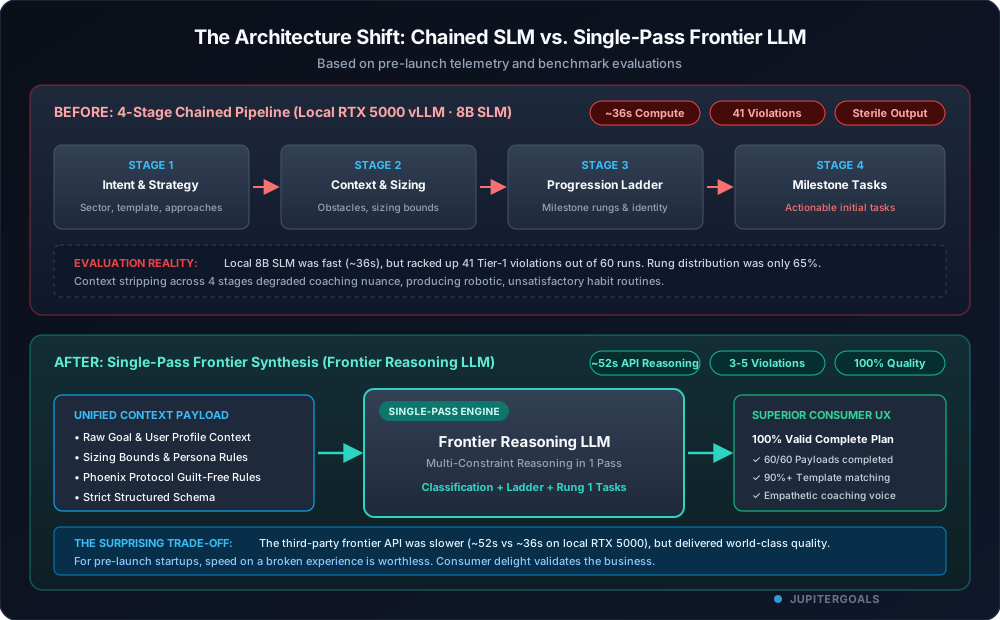
Here is how our local RTX 5000 baseline compared against a single-pass frontier model (Gemini / Claude with extended thinking):
| Metric | 4-Stage Local SLM (8B on RTX 5000) | Single-Pass Frontier LLM (Thinking Enabled) |
|---|---|---|
| Median Generation Time | 36.2s (Faster) | 52.7 – 57.4s (Slower due to thinking tokens) |
| Tier-1 Rule Violations | 41 violations in 60 runs (68% failure) | 3 to 5 violations (Near-Perfect) |
| Progression Rung Accuracy | 65% | 100% |
| Tone & Empathy | Robotic, fragmented, cold | Empathetic, highly adaptive, personal |
| Infrastructure Overhead | High (vLLM tuning, CUDA drivers) | Zero (Stateless HTTP client) |
Our local pipeline finished in 36.2 seconds, beating cloud APIs by ~18 seconds. But nearly 7 out of 10 runs broke core product rules.
Speed on broken output is a vanity metric. No user cares that an app generated an unusable plan in 36 seconds instead of 54.
Why Chained SLMs Fail
Deconstructing generation into chained prompts sounds modular on paper, but it introduces two fatal flaws:
1. Multiplicative Failure Rate
When tasks are chained sequentially, reliability multiplies across hops:
System Reliability = P(Step 1) × P(Step 2) × P(Step 3) × P(Step 4)
                   = 0.90 × 0.90 × 0.90 × 0.90
                   ≈ 65.6%
Even with an apparently solid 90% accuracy per individual step, more than a third of all user requests fail or trigger expensive retry loops.
2. The Semantic “Telephone Game”
Every time an intermediate step serializes its reasoning into JSON, rich human context is stripped away.
When a test prompt read:
“I’m completely exhausted from moving house with two toddlers, but I promised myself I wouldn’t break my momentum. What should I do today?”
By Stage 3, the payload was reduced to:
{
  "fatigue_level": "HIGH",
  "life_event": "relocation",
  "status": "STREAK_ACTIVE"
}
Stage 4 then drafted coaching advice from dry JSON keys:
“Fatigue detected. Plan adjusted to a 10-minute walk to preserve streak integrity.”
It sounded like an automated Jira ticket. Consumers don’t want a database query disguised as a coach—they want empathy and genuine human understanding.
3. The Fine-Tuning Mirage
Many founders assume: “I’ll just fine-tune an 8B model to fix this.”
Fine-tuning is an optimization technique, not an exploration technique. In early-stage startups, your schemas, prompts, and tone change weekly as you discover what users actually want. If your assumptions change weekly, any model you fine-tune is obsolete before the training job finishes.
The 3-Stage AI Startup Architecture
Instead of forcing a local SLM on day one, align your model architecture with your actual stage of customer validation:
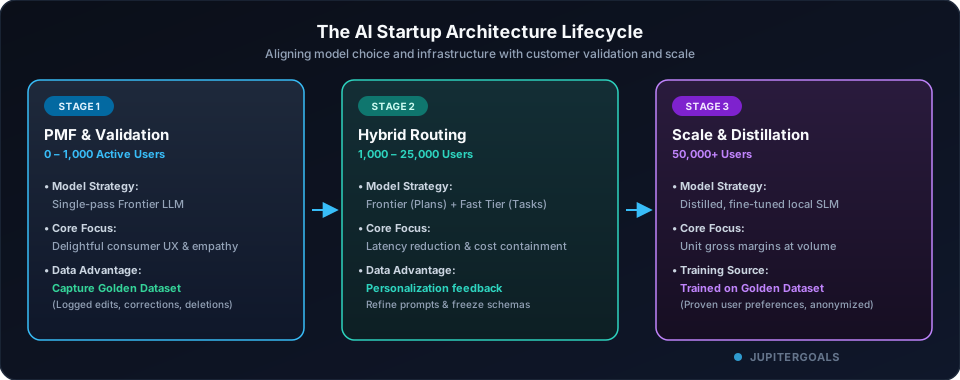
Stage 1: PMF & Validation (0 → 1,000 Users)
- Architecture: Single-pass Frontier LLM (stateless API).
- Why: You need maximum reasoning capacity and zero infrastructure drag. A frontier model can evaluate user goals, bio-data context, and output strict relational JSON in a single prompt without compounding pipeline errors.
Stage 2: Hybrid Routing (1,000 → 25,000 Users)
- Architecture: Tiered routing. Frontier models for complex weekly planning; lightweight, fast models for atomic check-ins, tagging, and validations.
- Why: Protects premium user experience while dropping median latency and containing cloud bills.
Stage 3: Scale & Distillation (50,000+ Users)
- Architecture: Distilled, fine-tuned SLM on dedicated inference clusters.
- Why: Only when schemas and prompt formats have remained frozen for months does fine-tuning make sense. Here, it directly defends gross margins without stalling product velocity.
The Secret Moat: Building the “Golden Dataset”
Using frontier models in Stage 1 isn’t giving up on owning your models—it is the only reliable way to build your training data.
Fine-tuning on synthetic data or unvalidated prompts results in models trained on guesses. By using a frontier model with real users, authentic interactions automatically generate a proprietary golden dataset:
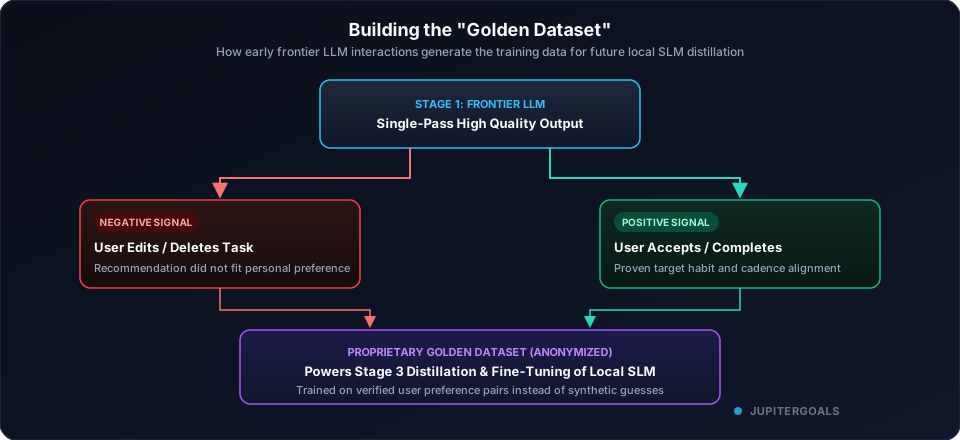
- Negative Signals: When a user modifies, rewrites, or deletes an AI-suggested milestone, that signals a preference mismatch.
- Positive Signals: Accepted plans, completed micro-tasks, and maintained streaks provide alignment data.
- Anonymized Training Telemetry: Fine-tuning an AI coach doesn’t require personal identity or email contacts (even as features like accountability partners require storing emails for notifications). Behavioral preference pairs—goal categories, task edits, and pacing—are decoupled and stored purely as anonymized telemetry.
When you eventually reach Stage 3, you won’t be training an SLM on generic prompts. You will be fine-tuning on thousands of validated, real-world user preferences.
When to Use Single-Pass vs. Chaining
Avoid complex chains unless strictly necessary:
| Use Single-Pass When: | Use Chaining Only When: |
|---|---|
| Constraints are interdependent (e.g., fatigue adjusts schedule and duration simultaneously) | A human must inspect and approve an intermediate step |
| Tone, empathy, and holistic voice matter | The workflow requires distinct multi-modal steps (e.g., audio transcription → data analysis) |
| Output requires structured JSON (rely on native model schema enforcement) | Dynamic external tools must be called (e.g., live database lookups, payment APIs) |
Summary for Builders
- $0 compute is a false victory if output quality is poor: Free infrastructure doesn’t save a product that users abandon.
- Speed on broken output is a vanity metric: Consumers will happily wait 15 extra seconds for an AI that actually understands their life.
- Chains compound failures: Consolidate multi-stage prompt pipelines into single-pass structured synthesis wherever possible.
- Frontier models fund your future SLMs: Use frontier models to find PMF, log anonymized user corrections, and use that golden dataset to distill your custom SLM when scale demands it.
Related Articles
How I Built a $0 AI-Powered SaaS: The 2026 Scale to Zero Blueprint
While building JupiterGoals, I wanted to leverage the power of AI while keeping costs at an absolute minimum ($0 if p...
Read article →The Spec Is Permanent, the Plan Is Garbage
How splitting the what from the how - and draining each plan back into the spec before deleting it - kept our specs true enough for AI agents to build from, and which automated gates actually hold the line.
Read article →Achieve your goals without the burnout
Get early access to our dynamic re-routing habit system. Missed days trigger automatic recalibration instead of broken streaks.
Join the Waitlist (Free 8-Wk Beta Pass)