Scaling Loop Engineering: Running Parallel AI Clones on Trunk Without git worktree
In Part 1, I covered how wrapping a living specification in a quantifiable /goal loop lets an AI agent plan, implement, and verify a feature without human babysitting.
Once a single /goal loop works reliably, you hit the next bottleneck: serial checkout throughput.
One checkout is a single queue: one working tree, one Git index, one set of local ports, and one database container. If you have 15 specs in your backlog, running them one by one leaves your machine and your multi-harness token quotas idle while you step away.
Most engineers reach for git worktree to run parallel agents. If you only use a single AI harness and use feature branches, git worktree is often enough.
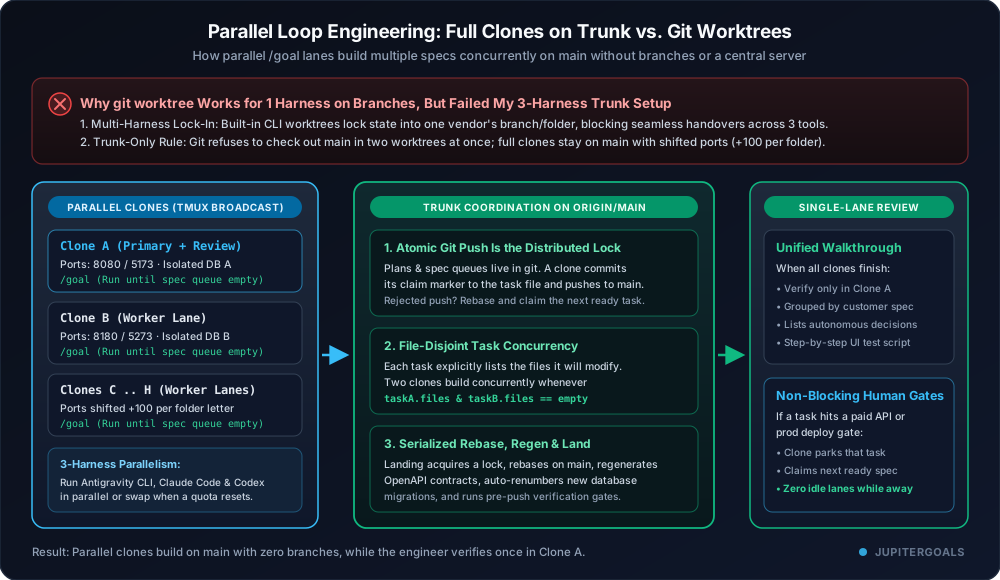
However, because I run three harnesses interchangeably (Antigravity CLI, Claude Code, and Codex) and practice strict trunk-based development (committing straight to main with no branches), git worktree broke down immediately. Instead, I use 8 separate full clones (Clone A through Clone H) committing straight to main.
Here is when git worktree is fine, why it fails across multiple harnesses on trunk, and how to review eight lanes of work in one place.
Why Full Clones Beat git worktree When You Run 3 Harnesses on Trunk
Every design in an agent-driven repo must minimize what it costs to keep correct across future prompts:
| Setup Choice | When It Works vs. Why It Failed My Setup | How 8 Full Clones (Clone A..H) Solve It |
|---|---|---|
| 1. Multiple Agents in One Folder | Fails immediately: agents in the same checkout overwrite uncommitted files and clash on the same Git index, local ports (8080, 5173), and database container. | Each agent gets its own folder, and a small script reads the folder letter (a to h) to shift ports (+100 per letter) and database volume names automatically. |
| 2. Built-in CLI Worktrees | Works if you only use 1 harness on branches. Fails across 3 harnesses: Claude Code worktrees and Codex sandboxes lock state into tool-specific branches and folders that other harnesses cannot cleanly resume. | Plain clone folders are 100% tool-agnostic: Antigravity CLI, Claude Code, and Codex can run side by side or take over a stalled clone the moment a quota limit hits. |
3. Manual git worktree | Works if your workflow uses feature branches. Fails on strict trunk: Git refuses to check out main in two worktrees at the same time, forcing branch creation and merge ceremonies. | Every full clone checks out main directly and lands via git pull --rebase and git push. Zero branches. |
Because my agent rules, specialist prompts, and skills are generated from a single vendor-neutral source into all three harnesses, a clone is completely harness-agnostic. I can run Antigravity CLI in Clone B, Claude Code in Clone C, and Codex in Clone D simultaneously. If one harness hits its 5-hour usage cap mid-task, I open a different harness in that exact same clone and it resumes from the task handoff file and git diff without losing a step.
I also rejected domain-owned lanes (assigning one clone to planning and another to account). In an audit of 16 backend commits, 9 touched two to four domains, 12 changed the OpenAPI contract, and 7 added a database migration. Real features cut across domains, so every clone acts as a general-purpose worker pulling from one shared queue.
Coordinating 8 Clones Without a Central Server
When you broadcast /goal across eight tmux panes at once, how do you stop clones from grabbing the same spec or overwriting each other’s files? Git itself is the coordinator:
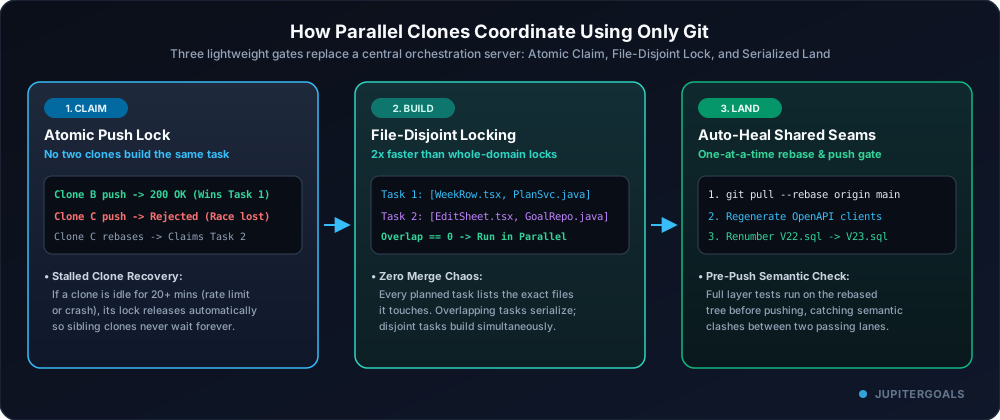
- Atomic Git Push Is the Lock: Task plans live in tracked markdown files on
main. To claim a task, a clone writes its ID into the task file and pushes tomain. IfClone BandClone Crace within 50 milliseconds, Git accepts one push and rejects the other; the losing clone rebases and claims the next ready task. If a clone goes idle for 20 minutes (rate limit or crash), its lock releases automatically. - File-Disjoint Concurrency (2x Faster): Every planned task explicitly lists the files it will touch (
.java,.tsx,.py). Two clones run in parallel whenever their file lists do not overlap (taskA.files & taskB.files == empty), cutting multi-task build times in half. - Auto-Healing Shared Seams on Land: Full-stack tasks inevitably meet at two shared seams: generated OpenAPI clients and numbered database migrations (
V{n}__*.sql). A local landing lock serializes pushes one at a time: it rebases ontomain, regenerates OpenAPI clients from source instead of hand-merging them, auto-renumbers colliding migrations (V22toV23), and runs pre-push test gates before pushing.
Solving the Human Review Bottleneck
When eight clones land multiple specs an hour, the human engineer is the bottleneck. Two rules keep you out of review hell:
- Park Tasks, Never Clones: Human gates are reserved strictly for actions that cost money, touch production, or require an irreversible product trade-off. When a clone hits a human gate, it lands its commits, parks that task, and immediately claims the next ready spec.
- Verify Once in
Clone A: You never inspect eight terminals. When the queue is empty,Clone Ais the only checkout you open. Its agent pullsmainand generates one Unified Customer Journey Walkthrough grouping every autonomous design decision and step-by-step browser test script by spec.
# Broadcast across Clones A..H via tmux, then review once in Clone A:
/goal Work through the approved spec queue, claiming and landing ready tasks until the queue check reports zero ready specs and zero active lanes.
The Takeaway
- If you use one harness and feature branches,
git worktreeis fine; if you use multiple harnesses (Antigravity CLI, Claude Code, Codex) or commit straight tomain, use full clones so any tool can take over any folder without branch lock-in. - Shift ports and database volumes by folder name (
athroughh) so 8 checkouts can run tests simultaneously on the same machine without colliding. - Lock with
git pushand file lists instead of building complex external orchestrators. - Auto-regenerate contracts and renumber migrations on rebase so shared seams never block parallel lanes.
- Build in N clones, verify in 1 (
Clone A).
Once you can run up to eight clones in parallel, the next question is knowing how long a plan will take and whether a specific spec actually benefits from 2 lanes or 7. In Part 3, I cover how I use git log and the plan’s dependency graph (DAG) to forecast agent build time and pick the exact number of lanes to run.
(If you want to try what I’m building with this workflow, you can start 7 days free on Max, no card needed.)
Related Articles
Codex vs Claude Code vs Antigravity CLI: Which AI Coding Agent Is Worth It?
I ran three AI coding harnesses side by side on their entry-level plans. One burned through my limits fastest and still needed the most retries. Here is what I saw, why it happens, and the harness-agnostic setup I'm sticking with.
Read article →Why I Don't Persist Technical Specifications
When refactoring my entire backend and worker architecture to asynchronous serverless tasks, I didn't write a technical spec. Here is why separate technical specs are an anti-pattern, and the 7 homes where technical truth actually lives.
Read article →All your goals. One realistic plan.
JupiterGoals fits everything you're working toward into one plan sized to your day. Shrink or swap a step on hard days and keep moving.
Start freeNot ready to sign in? Get product updates by email →